Guide
Pattern Scale and Repeat: How to Choose the Right Size for Wallpaper and Fabric
# Pattern Scale and Repeat: How to Choose the Right Size for Wallpaper and Fabric Most pattern mistakes are not choices of style. They are choices of size. A design that looks beautiful on screen can land badly on a wall for reasons that have nothing to do with the drawing: the motif is too big for the space, the repeat is too obvious, or the print was scaled without anyone checking what it would look like from two metres away. The colours were never the problem. Scale and repeat are the two least discussed parts of working with pattern and the two that decide most outcomes. This guide covers how both work, the rules designers actually use to size a print, and the practical consequences that only show up once something is being printed.
Scale Is the First Decision, Not the Last
Walls Need Love's residential scale guide does not hedge on this, calling scale "the single most important factor in whether a wallpaper choice enhances or disrupts a space."
Its working definitions are worth holding on to. Large-scale patterns "create visual drama and work best in rooms with generous wall space," with the specific risk that in a tight space the pattern may fragment before it completes a single repeat. Medium-scale is "the most versatile option in residential wallpaper design," which is why it is the safe default. Small-scale patterns "add surface texture and depth without demanding attention," which makes them the right answer far more often than people expect.
The one concrete measurement it gives is a useful anchor: "A 9-foot ceiling can carry a medium-scale pattern comfortably. A 12-foot ceiling opens the door to large-scale murals and oversized repeats."
Crucially, the same guide pushes back on the most common assumption in the category: "Small rooms can handle large wallpaper patterns when the design is balanced properly. Intentional use and proportion matter more than square footage alone."
The Rules of Thumb That Actually Help
Several sources converge on a small set of tests that are more useful than any general principle.
The quarter rule. Olive et Oriel's scale guide offers the most directly applicable benchmark available: "If the pattern repeat is larger than roughly one-quarter of your shortest wall dimension, it may feel overwhelming on all four walls." That converts an aesthetic judgement into a measurement you can take before ordering.
The showcase test. Speaking to Sunset, designer Patty Hampton of Refresh Your Space frames the failure modes at both ends: "If the room is too small, and the scale of the pattern is too large and it can't be showcased, that can be an issue. If the scale is too small, then it skews too neutral and gets lost." Her follow-on question is the practical one to ask of any wall, which is how much of the pattern can actually be shown.
The focal point question. Hampton's other rule is about hierarchy. When the wallpaper is meant to be the focus of the room, "go for a larger scale or more vibrant pattern." When artwork, a rug or a piece of furniture is meant to lead, the pattern should be smaller and quieter. Two competing focal points is the most common way a well-chosen paper still ends up looking wrong.
Compare the pattern to what touches the wall. A motif that is close in size to a headboard, a shelf gap or a backsplash height will read as an accident. Matching the print's visual weight to the furniture in front of it does more for a room than matching it to the room's dimensions.
The sample size rule. Walls Need Love is blunt about testing: samples should be at least 12 inches square, because "A 4-inch swatch tells you almost nothing." A swatch smaller than one repeat cannot show you the thing you are actually judging.
Colour Changes How Big a Pattern Looks
Scale is not purely a matter of measurement, because contrast does some of the work.
Olive et Oriel notes that a large pattern in tonal colours, meaning several values of the same hue, "feels more contained than the same pattern in high-contrast colours." This is the single most useful lever available when you love an oversized design but are nervous about the room. The same artwork in a low-contrast colourway behaves like a smaller pattern.
Direction matters too. The same guide notes that "Horizontal patterns visually widen a room; vertical patterns make ceilings feel higher," which is worth knowing before choosing between two versions of a design that differ only in orientation.
This interaction between scale and contrast is why our guides on oversized floral wallpaper and on dark floral wallpaper reach quite different conclusions about coverage, despite both dealing with bold designs.
What a Repeat Actually Is
A repeat is the distance between one point in the design and the next identical instance of that point. Everything else about tiling follows from it.
Roman Decorating Products' guide to measuring repeats gives the method plainly: "Unroll a section of the wallpaper on a flat surface. Choose a specific point in the pattern (like the top of a particular object) along the seam and measure from that point to where the exact point appears again vertically down the roll." It sorts papers into no-repeat or random match, which is "the simplest type of wallpaper to install because it doesn't require matching patterns along the seams," small repeats under 12 inches, and large repeats over 12 inches that demand careful planning.
The way the repeat unit is laid out has its own vocabulary. The Your Colors repeat pattern reference defines a block or straight repeat as a unit "duplicated and arranged in a straightforward grid, horizontally and vertically, without any offset," best suited to geometric and symmetrical designs but prone to looking rigid. A half-drop repeat offsets alternate columns "by exactly half the height of the repeat unit," which suits organic designs and florals, though it can create unintended striping if the motifs line up in an unlucky way.
Pattern Observer explains why the half drop dominates textiles. A full drop repeats perfectly along both the vertical and the horizontal, which means the grid can become obvious with larger or bolder motifs. The half drop staggers the horizontal, and is far better at concealing the repeat inside the finished design. The stated goal for both is a repeat that is undetectable, so the eye reads the motifs rather than the structure holding them.
For structured, symmetrical work, our covers where the straight grid is an asset rather than a liability.
Repeat Size Has a Price
This is the part that surprises people, and it is worth knowing before falling in love with an enormous repeat.
Larger repeats waste more material, because each drop has to be aligned to the last and the offcut is discarded. Roman Decorating Products puts real numbers on it for a 384 square foot room. A no-repeat paper yields about 25 usable square feet per roll, needing 16 rolls. A small repeat under 12 inches yields about 22 usable square feet, needing 18 rolls. A large repeat over 12 inches yields about 18 usable square feet, needing 22 rolls.
That is roughly 37 percent more material for the large repeat than for the random match, on identical walls. On an expensive paper, the repeat size can matter more to the final bill than the price per roll does.
The same principle applies to fabric, where a large repeat means more waste when cutting to a pattern, and to any product where the artwork has to be positioned rather than simply tiled.
Choosing Scale for Products Rather Than Rooms
Wallpaper is only one destination, and the rules shift by application.
Stationery and packaging need small scale almost without exception, because the visible area is tiny. A pattern that will appear on a card back, a label or a gift tag must complete several repeats in a few centimetres or it reads as a random crop rather than a pattern. Our botanical patterns for product packaging guide covers that constraint in detail.
Apparel and soft furnishings sit in the middle, and depend heavily on how the fabric is cut. A large repeat on a cushion is fine, because the panel is roughly the size of the repeat. The same repeat on a sleeve is not.
Rooms treated as a whole surface are the one place oversized patterns are unambiguously at home, which is the subject of our pattern drenching guide.
Small-scale prints are the most portable of all, which is why the ditsy category has such staying power across completely different products. Our ditsy floral patterns guide covers that range specifically.
Where Patterio Fits
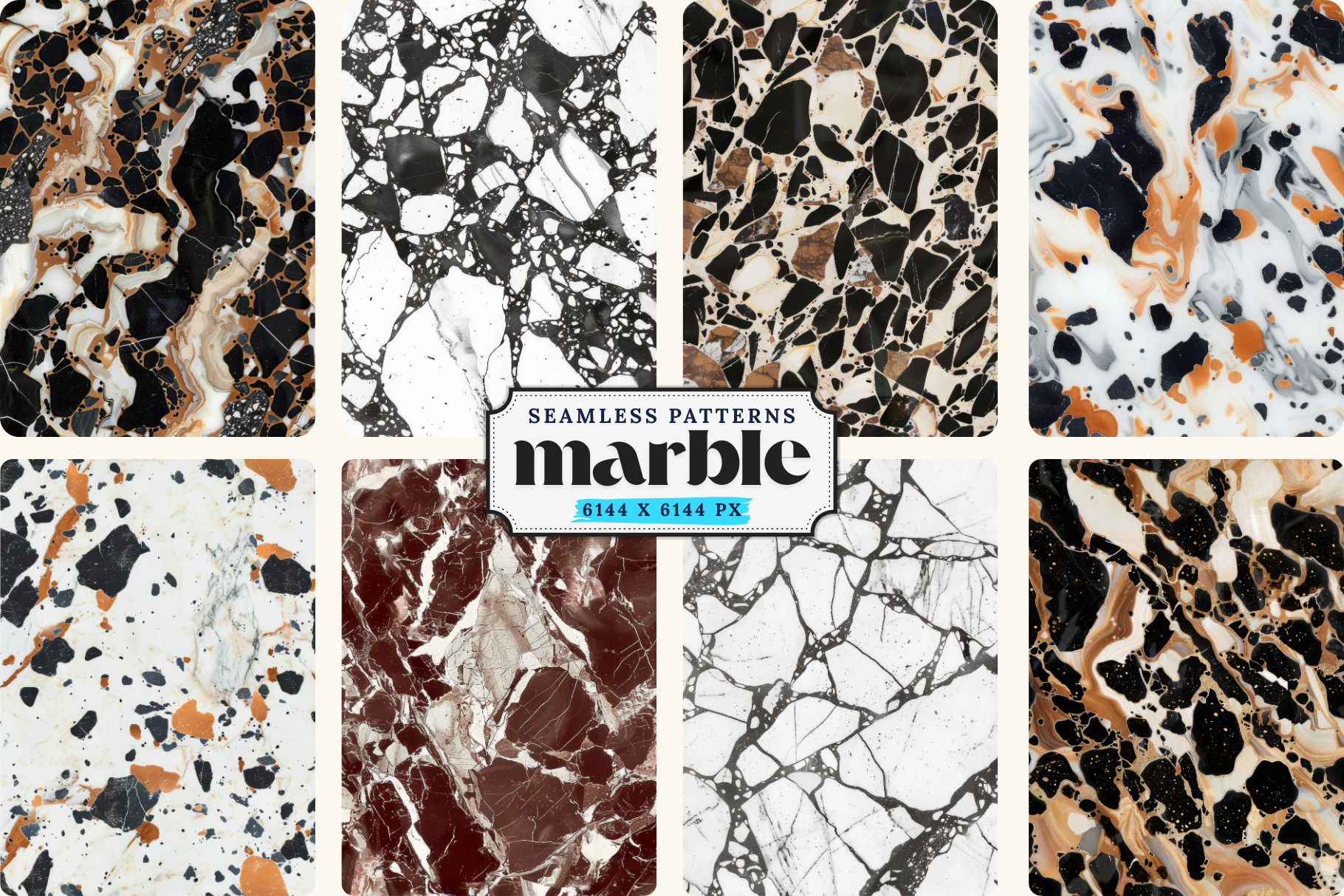
Every Patterio design is a seamless repeat supplied at 6144 x 6144 px and 300 DPI. At 300 DPI that tile is just over 20 inches square at full size, which is what makes the same file usable in more than one place.
Printed at full size it behaves as a large-scale pattern suitable for feature walls and full-room coverage. Printed at half size it becomes a medium-scale pattern for general wallpaper and furnishing fabric. Reduced further it becomes a small-scale texture for stationery, packaging and gift wrap, with plenty of resolution in hand.
The practical consequence is that scale becomes a decision you make at print time rather than at purchase time. One file covers the wall, the cushion and the card, and the only thing that changes is the percentage you print it at. The full range is in the shop.
The Test Worth Running Every Time
Before committing to any pattern at any size, do one thing: print or view it at the size it will actually be used, and look at it from the distance it will actually be seen.
A pattern judged at arm's length on a screen is being judged at neither. Most scale errors would be caught in the two minutes it takes to print a 12 inch square, tape it to the wall, and walk to the other side of the room.
Scale is the one property of a pattern that cannot be fixed after the fact. Colour can be adjusted, a room can be restyled around a print, and a paper can be hung on one wall instead of four. A motif that is the wrong size for the space it is in stays wrong, and no amount of styling around it will settle the room down.
Ready to start?
Browse seamless pattern bundles