Guide
Dark and Black Floral Wallpaper: A 2026 Guide to Moody, Jewel-Tone Blooms
# Dark Floral Wallpaper: A 2026 Guide to Moody, Jewel-Tone Blooms For most of the last decade, a floral wallpaper meant something pale. Small buds, a soft ground, a whisper of color behind the furniture. In 2026, that quiet version has stepped back and a bolder one has taken its place. Dark floral wallpaper, all deep grounds and oversized blooms in jewel tones, is now one of the most talked about looks in interiors. This is not a passing novelty. It is the meeting point of two of the year's strongest movements: the return of maximalism and the shift toward rich, saturated color. Put them together and you get walls that read more like artwork than backdrop. This guide covers what is driving the trend, the palettes worth knowing, how to choose a bloom that lasts, and the rooms where moody florals do their best work. The goal throughout is drama that feels considered rather than heavy.
Why Dark Florals Define 2026
The clearest signal comes from the wallpaper world itself. In its 2026 wallpaper trends report, William Morris Wallpaper calls maximalism "the single biggest trend," noting that "rooms that would have been painted gray in 2018 now wear bold heritage florals, dense botanicals, and chinoiserie murals." The same report describes how "moody floral wallpapers in deep black and charcoal grounds appear in master bedrooms, dining rooms, and powder rooms across all major retailers."
This is the floral, grown up. The buds have become full blooms. The pale background has gone deep. The effect is closer to a still life than to a sprig of pattern.
The broader interiors picture supports the same direction. Homes & Gardens frames 2026 as the year homes become "warmer, layered, and increasingly focused on personality," predicting that "the biggest homes in 2026 won't be the most minimalist, but the most personal, comforting, and full of soul." A dark floral wallpaper is one of the fastest ways to give a room exactly that kind of soul.
The Jewel-Tone Palette Doing the Work
If dark florals are the shape of the trend, jewel tones are the color. The William Morris report is specific here too, noting that "deep forest green, oxblood, plum, and chartreuse have replaced the cool palette that dominated 2015 to 2022," with "deep forest green leading the year."
Designers are leaning into these saturated colors with real confidence. In a Livingetc roundup on decorating with jewel tones, Zoe Feldman of Zoe Feldman Design makes the case for commitment: "Garnet works best when it's given space to breathe and used expansively rather than as a small accent." She adds that it pays to "layer it with complementary textures and tones like creamy neutrals, aged woods, and even unexpected patterns."
For the blues, Susie Pfeiffer of Pfeiffer Design offers a steadier note. "Balance is essential," she says of sapphire. "Pair it with natural textures to ground it and prevent it from feeling overly dramatic." That single piece of advice, ground the drama with something natural, is the thread that runs through every successful dark floral room.
The deep blues are showing up in textiles as much as on walls. In its 2026 fabric trends report, All About Fabrics describes how "sapphire, midnight, storm blue, and ink create a luxurious, modern look," which is exactly the kind of palette a moody floral pattern lives inside.
Black, Charcoal, or Just Very Dark?
There is a real difference between a black floral and a dark one, and it changes how a room feels.
A true black ground is the most graphic choice. The flowers sit against nothing at all, so the contrast is absolute and the pattern reads almost like an illustration on paper. This is the look that photographs beautifully and stops people in a hallway. It is also the least forgiving, because a true black shows every seam, every scale mistake, and every colour in the bloom that is not quite right. If you use it, keep the palette tight.
Charcoal and near-black are softer and, in a room you actually live in, usually easier. A very deep grey or a black warmed with brown holds shadow the way a painted wall does, so the blooms feel like they are emerging from depth rather than floating on a flat plane. The William Morris report quoted above puts "deep black and charcoal grounds" in the same breath for exactly this reason: in a finished room the two do similar work, and the choice is about how much drama you want.
Then there are the grounds that read as black but are not. Inky navy, deep aubergine, and the darkest forest greens all behave like black from across a room, and then reveal their colour up close. These are the safest choice for a whole wall, because the hint of colour keeps the surface from feeling like a hole. If you are nervous about committing to black, this is where to start.
One practical note for anyone printing rather than buying by the roll. Very dark grounds drink ink, and a black that looks rich on screen can come out flat or slightly grey on matte paper and on fabric. Order a sample before you commit to a run, and if the pattern is going on textile rather than paper, expect the ground to lift a shade or two.
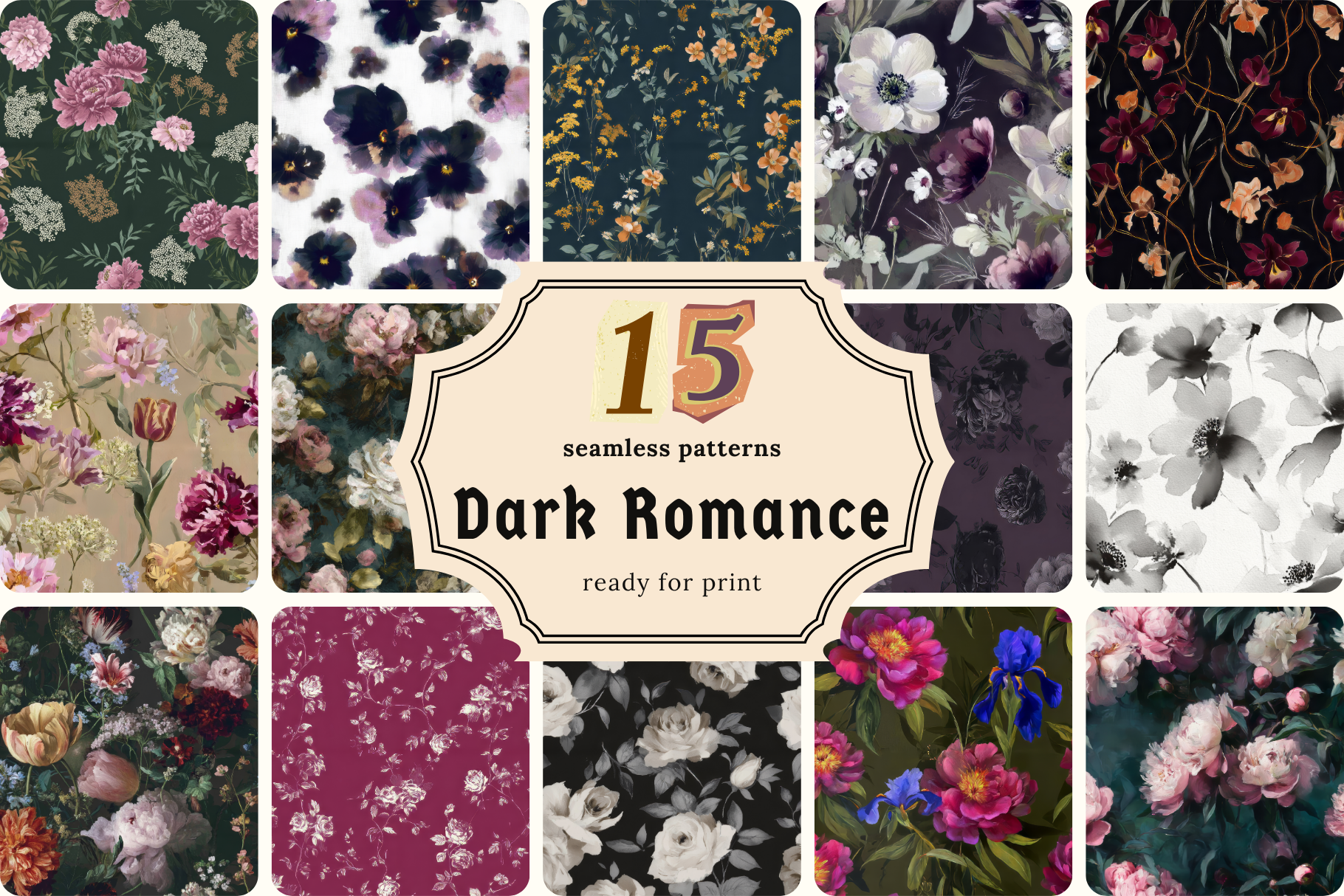
If you want to see the difference rather than read about it, the dark and black florals collection gathers the sets built on these grounds in one place.
Choosing the Right Bloom
Not every floral works on a dark ground. The ones that do tend to share a few qualities.
Scale is the first. The 2026 floral is large. All About Fabrics points to "large-scale blooms, think lush peonies, wildflowers, and abstract roses" as the prints set to dominate, and a deep background gives those big blooms somewhere to glow. A small ditsy print can disappear into a dark ground, while an oversized peony reads from across the room.
Depth is the second. The most convincing dark florals have a painterly, layered quality, with petals and stems that seem to recede into shadow. This is what separates a pattern that feels like fine art from one that feels like a sticker. Look for soft edges, tonal shifts, and a sense that the flowers are emerging from the dark rather than sitting flat on top of it.
Restraint in the palette is the third. A dark floral does not need every color. A garnet bloom and a forest stem on an inky ground will almost always feel more expensive than a busy rainbow. The discipline is in choosing two or three tones and letting the deep background do the rest.
Where Moody Florals Belong
One of the most useful ideas in 2026 decorating is the jewel box room: a small space treated lavishly, so that walking into it feels like opening something precious. Dark florals are made for this.
Powder rooms are the classic example. A windowless cloakroom is often treated as an afterthought, but it is the perfect place to commit fully to a moody floral. With no natural light to fight, the deep ground becomes an asset, and the small footprint keeps the look from overwhelming the home.
Dining rooms are the second natural home. Because dining happens mostly in the evening, a dark floral wallpaper reads beautifully under lamplight and candle glow, when the deep tones feel their richest. Andy Greenall of Paint & Paper Library, quoted in the same Livingetc piece, suggests "opting to use deep, jewel tone colors in the smallest room in the house" for anyone still nervous about saturated color, which makes a compact dining space or snug an ideal starting point.
Bedrooms round out the list. A moody floral behind the bed turns the headboard wall into a cocoon. Here the advice to balance is most important. A deep floral feature wall works best when the bedding, curtains, and flooring stay calm and natural.
How to Keep the Drama from Feeling Heavy
The line between cocooning and oppressive is real, and it is easy to cross. A few principles keep a dark floral feeling intentional.
Let natural materials do the grounding. Timber, rattan, linen, and aged metals all soften a saturated wall. David Flack of Flack Studio, also in the Livingetc roundup, recommends balancing rich color "with warm materials, timber, brass, textiles, vintage rugs," noting that the right pairing makes a deep shade feel "cocooning and intimate" rather than cold.
Echo the wallpaper's colors elsewhere, lightly. Pfeiffer's advice to add "small tonal echoes, perhaps through accessories, upholstery, or artwork" applies perfectly to a patterned wall. A garnet cushion or a forest green lampshade pulls a single bloom out of the wallpaper and into the room.
Choose one feature and let the rest breathe. A dark floral does not need to wrap every wall. Used on a single anchor wall, behind a bed, or inside one small room, it has all the impact without the weight.
Styling Dark Florals Across the Home
A dark floral wallpaper rarely lives alone. The rooms that work tend to layer it with a few other moves.
Lighting matters more than usual. Warm, layered light, table lamps, picture lights, candles, brings out the depth in a moody pattern, while harsh overhead light can flatten it. Plan the lighting alongside the wallpaper, not after.
Texture is the quiet partner. Velvet, bouclé, and natural linen all catch the light differently and stop a deep room from feeling like a flat block of color. A velvet headboard against a sapphire floral, or a linen sofa against an oxblood bloom, gives the eye somewhere soft to land.
Art and mirrors keep things from feeling like a showroom. A gilt mirror or a small framed piece on a patterned wall adds a layer of personality and reflects light back into the space.
Where Patterio Fits
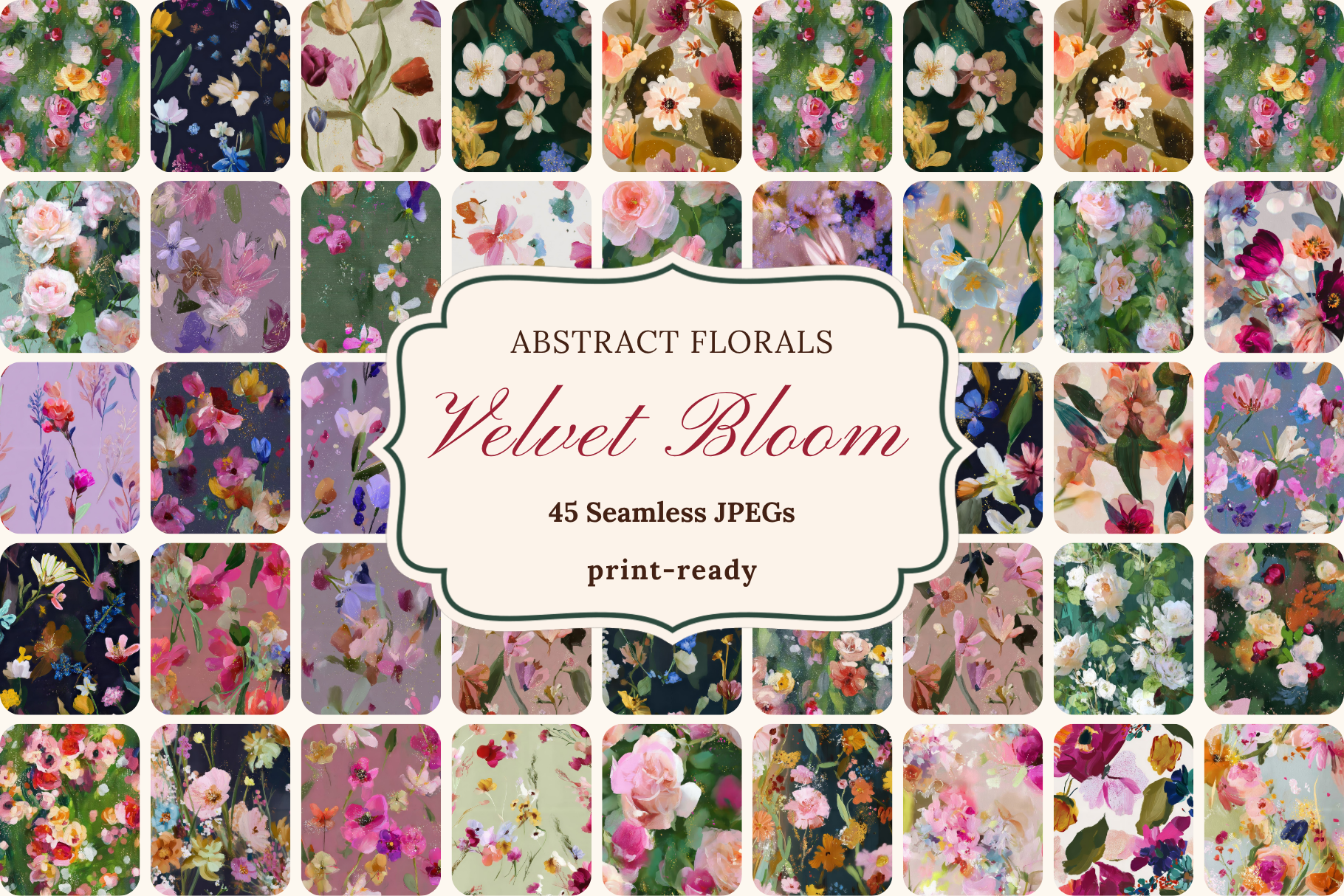
Patterio's seamless pattern collections are built for exactly this moment. Soft, painterly blooms in deep, saturated palettes, designed to sit on dark grounds and read as artwork rather than wallpaper filler. They suit interior designers specifying a feature wall, makers producing peel and stick murals, and small brands developing a moody product line.
If you are drawn to the jewel-tone direction, the floral collection is the place to start, with delicate and dramatic blooms ready to license across wallpaper, fabric, and stationery. For the maximalist layering that pairs so well with a dark floral, our guide to pattern drenching with florals shows how to commit a whole room to print. And for the heritage end of the look, vintage botanical pattern wallpaper and our botanical pattern trends guide cover the broader botanical movement feeding into 2026.
A Final Word on Confidence
Dark floral wallpaper rewards conviction. The pale, safe floral asks nothing of a room and gives little back. The deep, jewel-tone version asks for a small leap, a windowless cloakroom, a single bedroom wall, a dining room that mostly lives at night, and returns a space with genuine atmosphere.
The designers shaping 2026 agree on the method even when they disagree on the color. Commit to the deep tone, ground it with something natural, and let one beautiful bloom carry the room. Done that way, a dark floral is not heavy at all. It is the most memorable wall in the house.
Ready to start?
Browse watercolor pattern bundles