Guide
Art Deco Floral Patterns: A 2026 Designer's Guide to Geometric Blooms
# Art Deco Floral Patterns: A 2026 Designer's Guide to Geometric Blooms Art Deco florals sit at an unusual intersection. They are botanical and architectural at once, romantic in subject and disciplined in structure. A peony rendered in the Deco idiom is not a loose garden sketch. It is a bloom pulled into symmetry, framed by fans and stepped lines, and finished in gold on a dark ground. That tension between soft and precise is exactly why the style is having a moment again in 2026, a full century after the movement got its name. For designers, makers, and small brands, this is a commercially useful trend rather than a passing aesthetic. It reads as luxury without shouting, it photographs beautifully, and it carries across surfaces from wallpaper to packaging to stationery. This guide covers where the revival is coming from, what actually makes a floral pattern read as Deco, and how to use the look with confidence.
Why Art Deco Florals Are Back in 2026
The revival is not a hunch. It is showing up in the two places that matter most: what designers predict and what buyers actually purchase. Houzz built its 2026 forecast from a survey of its community of more than 70 million homeowners and 3 million design professionals, and named the return of Art Deco outright, with chevron patterns, brass accents, and jewel tones all called out as coming back to the spotlight (CultureMap, reporting on Houzz). The platform framed it as a blend of historical sophistication and contemporary sensibility, which is a fair description of where the floral versions land.
Sales data tells the same story. A 2026 surface-design trend report drawing on Spoonflower's best sellers identifies Art Deco geometric as the single best-selling wallpaper style by volume for the year, led by gold on dark grounds and structured, symmetrical layouts (Artfuly Pattern and Colour Trend Report). The most interesting note in that report is a hybrid direction: organic curves contained inside Deco frameworks, an "organic geometry" that is really just another name for the Deco floral. Demand is strongest exactly where botanical softness meets geometric containment.
The 1925 Roots That Still Shape the Look
Understanding the origin helps you design the pattern well rather than costume it. The style traces to the Exposition Internationale des Arts Decoratifs et Industriels Modernes, held in Paris from April to October of 1925, which drew around 16 million visitors and put decorative arts at the center of modern design (Dezeen's centenary series). The term Art Deco itself was not coined until the 1960s, drawn from that exhibition's full name.
What matters for florals is the lineage. As the National Building Museum explains, early Art Deco emerged as an evolution of Art Nouveau, the earlier style that embraced nature and organic, plant-like forms. After the First World War, those forms became more geometric, repetitive, and machine-like (National Building Museum). In other words, the flower never left. It was disciplined. Deco interiors leaned on bold geometric motifs such as zigzags, fan shapes, sunbursts, and stylized fountains and ferns, with Radio City Music Hall's radiating fan carpet as a classic reference. A Deco floral is a plant motif that has passed through that same filter of symmetry and stepped geometry.
What Makes a Floral Pattern Read as Art Deco
If you want a botanical to sit convincingly in this style, a handful of structural choices do most of the work.
Stylization over realism. Petals and leaves are simplified into clean, repeatable shapes rather than shaded naturalistically. Think of a rose reduced to concentric arcs, or a leaf flattened into a single confident silhouette.
Geometric containment. The bloom is framed. Fans, arches, scallops, and stepped borders hold each motif in place, and the repeat tends toward strict symmetry rather than the scattered, tossed layout of a cottage floral. The Spoonflower-based report describes this as clean geometric grids and structured symmetry, and it is the fastest way to signal Deco.
Radiating and stepped motion. Sunbursts, fan rays, and speed lines give the pattern directional energy. Even a static flower gains movement when its petals fan outward like a sunrise motif.
Metallic and high-contrast finishing. Gold, brass, and champagne line work against a deep ground is close to a signature. It is what separates a Deco floral from a plain geometric bloom.
Get these four elements right and the botanical subject matter becomes almost secondary. The grammar of the pattern carries the style.
The 2026 Color Story: Jewel Tones and Metallics
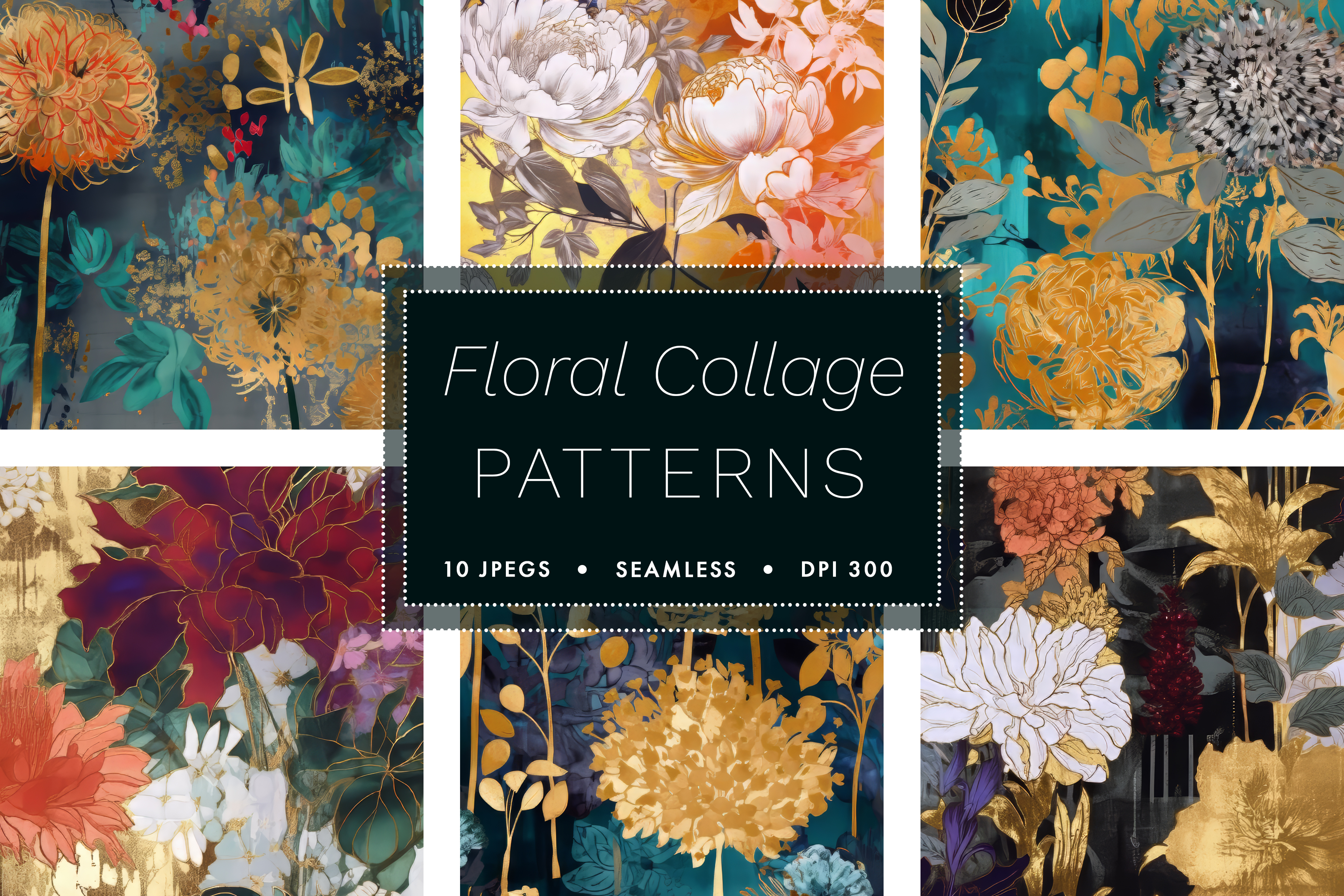
Color is where the current revival diverges most from the literal 1920s. Contemporary Art Deco floral wallpapers interpret the era with cleaner lines and more sophisticated palettes rather than straight reproductions, pairing rich jewel tones such as sapphire, emerald, and amethyst with metallics like gold leaf, copper, and champagne (Canvas and Ivy). Deep teal and gold on a near-black ground is a particularly strong 2026 combination for this look.
There is a softer route as well. The same jewel-tone geometry translates into muted, tonal versions: warm taupe line work on a soft off-white, or dusty emerald on cream, which keeps the Deco structure while reading calmer and more current. This flexibility is part of why the style suits so many projects. A powder room can take the full gold-on-black drama, while a stationery line or a candle label often works better in the restrained tonal palette.
Where Art Deco Florals Work Best
The strength of a geometric floral is its versatility across surfaces.
In interiors, it earns its keep on a single feature wall. Deco florals reward the spaces where a little glamour is welcome, such as entry halls, dining rooms, and powder rooms, and the geometry keeps them from feeling dated the way a purely trend-driven print might. Because the repeat is structured, alignment matters, so precise pattern matching is worth the extra care at installation.
For product and packaging, the framed, contained nature of the motif is a genuine asset. A Deco floral tile sits neatly inside a label border, a box lid, or a book cover, and the metallic-on-dark palette signals premium at a glance. If you are working on packaging, our guide to botanical patterns for product packaging covers scale and print considerations that apply directly here.
For stationery and soft goods, the smaller motifs shine. Fan-and-bloom repeats scale down gracefully onto cards, wrapping, tea towels, and cushions without losing their identity.
Scale and Placement: Getting It Right
Scale decides whether a Deco floral feels intentional or busy. Large-scale motifs, meaning design elements larger than roughly four to six inches, make bold statements and are best reserved for accent walls or hero surfaces where you want the pattern to be the focal point (Canvas and Ivy). Medium-scale repeats, around two to four inches, are the workhorses that carry a full room or a product range without overwhelming it. Small-scale versions, under two inches, give you texture and sophistication for stationery, linings, and secondary surfaces.
A reliable approach is to pair one dramatic surface with quiet neighbors. A bold Deco floral feature wall wants solid or subtly textured companions, not competing pattern. The same logic works in a product system: a statement box in the full jewel-tone print, paired with tissue and cards in a single tonal color drawn from it. For more on building repeats that hold together across a range, see our guide to geometric patterns for surface design.
Styling Art Deco Florals Without Tipping Into Costume
The risk with any revival is pastiche. Deco florals can slide into Great Gatsby theme-party territory if every cue is turned to maximum at once. The fix is restraint. Let the pattern be the period reference and keep everything around it current. Modern flat-panel furniture, natural materials, and plenty of negative space give a Deco floral room to breathe and read as sophisticated rather than staged.
Lean on the metallics sparingly. A single gold-line floral against a deep ground does more than a room where gold appears on the walls, the frames, the fixtures, and the trim. The best contemporary interpretations of the style borrow its geometry and its palette while dropping the literal 1920s excess, which is precisely how the current wave has stayed on the sophisticated side of the line.
Bring the Look Into Your Own Space
Art Deco florals are that rare trend with both heritage and momentum behind them: a century of design history, the top-selling wallpaper style by volume in 2026, and a structure flexible enough to move from a dramatic feature wall to a delicate card. Whether you want the full emerald-and-gold statement or a softer tonal take, the grammar is the same, and once you can see the geometry inside the bloom, you can use it anywhere.
If you would like a running start, explore Patterio's floral pattern sets for designer-curated repeats you can drop straight into interiors, packaging, and stationery projects, and browse the vintage collection for heritage-leaning motifs that pair beautifully with the Deco look. Every set is original, seamless, and ready for commercial work, so you can spend your time styling the room rather than building the pattern.
Ready to start?
Browse watercolor pattern bundles