Guide
Cyanotype Patterns for Fabric: A 2026 Maker's Guide to the Deep-Blue Look
# Cyanotype Patterns for Fabric: A 2026 Maker's Guide to the Deep-Blue Look There is a particular shade of blue that has been quietly spreading across fabric this year. Deep, inky, slightly luminous, set off by the ghostly white silhouettes of leaves and stems. It is the cyanotype look, a nineteenth century photographic process that has found a second life in textile and surface design, and in 2026 it is exactly in step with the wider mood for deep blues and botanical pattern. This guide is for makers and designers drawn to that look: sewists, quilters, soft furnishing makers, and small textile brands. It covers what cyanotype actually is, why it suits fabric so well, the best materials to work with, and how to capture the aesthetic at scale when a one-off print is not practical.
Why Cyanotype Is Surfacing on Fabric in 2026
The trend reports point straight at it. In its 2026 fabric trends report, All About Fabrics describes a palette where "sapphire, midnight, storm blue, and ink create a luxurious, modern look," with botanical motifs running right alongside. Cyanotype sits perfectly inside that description. Its signature deep blue is the color of the year, and its plant silhouettes are the botanical print designers are already reaching for.
The second pull is the appetite for character and craft. Reporting on the London Surface Design Show 2026, Houzz identified Modern Craft as a defining trend, with makers balancing "heritage and contemporary living," and Stylish Imperfection, the idea that "imperfection can feel authentic and personal." Cyanotype embodies both. It is a genuinely old process, and no two prints are ever identical. The slight unevenness that comes with sun exposure is not a flaw to be corrected. It is the appeal.
Put the two together, the right blue and the right kind of imperfection, and it is easy to see why the cyanotype look is showing up on everything from cushions to scarves this year.
What Cyanotype Actually Is
Cyanotype is one of the earliest photographic techniques. According to Jacquard Products, the maker of the most widely used kits, it was "discovered in 1842 and distinctive for producing rich, Prussian blue monochromatic prints." It became the standard way to reproduce documents and maps, which is where the word "blueprint" comes from.
The process is simple in principle. A surface is coated with two light-sensitive solutions, objects or a negative are placed on top to cast shadows, and the whole thing is exposed to sunlight. Where the light hits, the surface turns deep blue. Where the shadow falls, it stays white. A rinse in water fixes the image.
The story most makers love is the botanical one. The botanist Anna Atkins used cyanotype to record plant life, and as Art Spices notes, she produced "stunning blue botanical prints that became the world's first photographic book." Nearly two centuries later, that same pairing of deep blue and pressed botanicals is what defines the look on fabric.
The Best Fabrics for Cyanotype
Cyanotype is a natural fiber technique, which is part of why it appeals to makers working sustainably. Jacquard confirms the process works on "any natural fiber or porous surface, including cotton, linen, silk, canvas, wool, paper, wood and leather."
For garments and soft furnishings specifically, the sewing studio Seamwork narrows it down: "cotton, linen, viscose or rayon, and silk all work well," and white or off-white fabric "produces the most vivid results." Synthetics do not take the chemistry, so the process naturally steers makers toward the kind of natural, breathable cloth that suits clothing and home textiles anyway.
The weight and weave matter too. A smooth cotton lawn or a fine linen captures crisp plant silhouettes, while a heavier canvas suits totes and structured goods. The same deep blue reads differently across each, which is part of the fun of the technique.
The Botanical Look That Defines It
The reason botanicals dominate cyanotype is partly technical. Seamwork explains that makers favor plant material because "more sunlight can pass through a flower petal than a leaf," creating variation in opacity across a single print. A petal might register as a soft, translucent shape while a thick leaf prints as a hard white silhouette. That range of tone is what gives a good cyanotype its depth.
It is also why "pressed or fresh plants" are the go-to, as Seamwork notes, capturing intricate detail in the final print. Ferns, grasses, wildflowers, and trailing stems all photograph beautifully, their fine edges rendered in crisp white against the blue.
For a designer thinking about pattern rather than a single image, this botanical vocabulary is the heart of the style: delicate leaf forms, scattered stems, and loose meadow arrangements, all in negative against a deep blue ground. It is a soft, painterly look that reads as both vintage and thoroughly modern.
The Sustainability Appeal
A large part of cyanotype's revival is that it feels good to make. Art Spices describes the process as "refreshingly straightforward and environmentally safe," requiring "no darkrooms, no harsh chemicals, and no toxic waste." It is, in their words, "powered by nature," using sunlight as its only energy source.
For small textile makers, that matters. It means custom printed fabric can be produced in a kitchen or garden with minimal equipment, no industrial dye runoff, and very little waste. As Art Spices puts it, designers value the technique for "introducing natural patterns and texture into their handmade goods," especially for sustainable fashion and home decor.
This is the same instinct driving the Modern Craft trend the trade shows reported: a desire for textiles with a real process behind them, made in small batches, with a story attached.
From One-Off Prints to Repeatable Patterns
Cyanotype's beauty is also its limitation. Because every print is exposed by hand under the sun, the process is slow and each piece is unique. That is ideal for a one-off wall hanging or a small run of scarves. It is much harder when a maker needs yards of consistent fabric, a repeating pattern for a product line, or artwork that prints cleanly at any scale.
This is where seamless digital patterns earn their place. A well-designed cyanotype-style pattern captures the deep blue ground, the soft botanical silhouettes, and the painterly variation of the original look, while tiling perfectly across any length of fabric and reproducing identically every time. For a maker, that means the cyanotype aesthetic can carry an entire collection, not just a single piece, and can move from fabric to packaging to stationery without losing its character.
The trade-off is honest: a printed pattern is not a sun-exposed original, and it does not pretend to be. What it offers is consistency and scale, so the look that started as a slow studio experiment can become a viable product range.
Where Patterio Fits
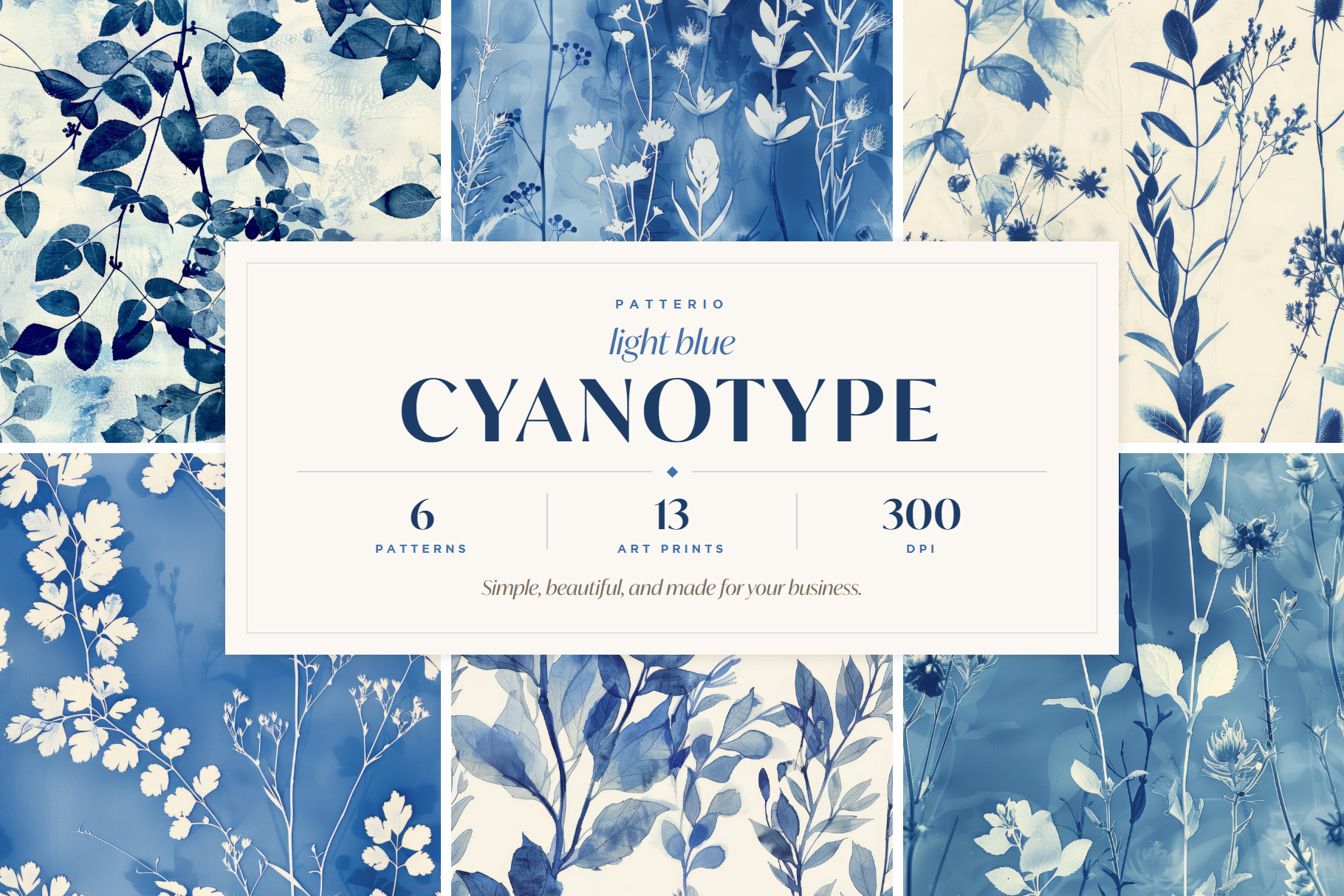
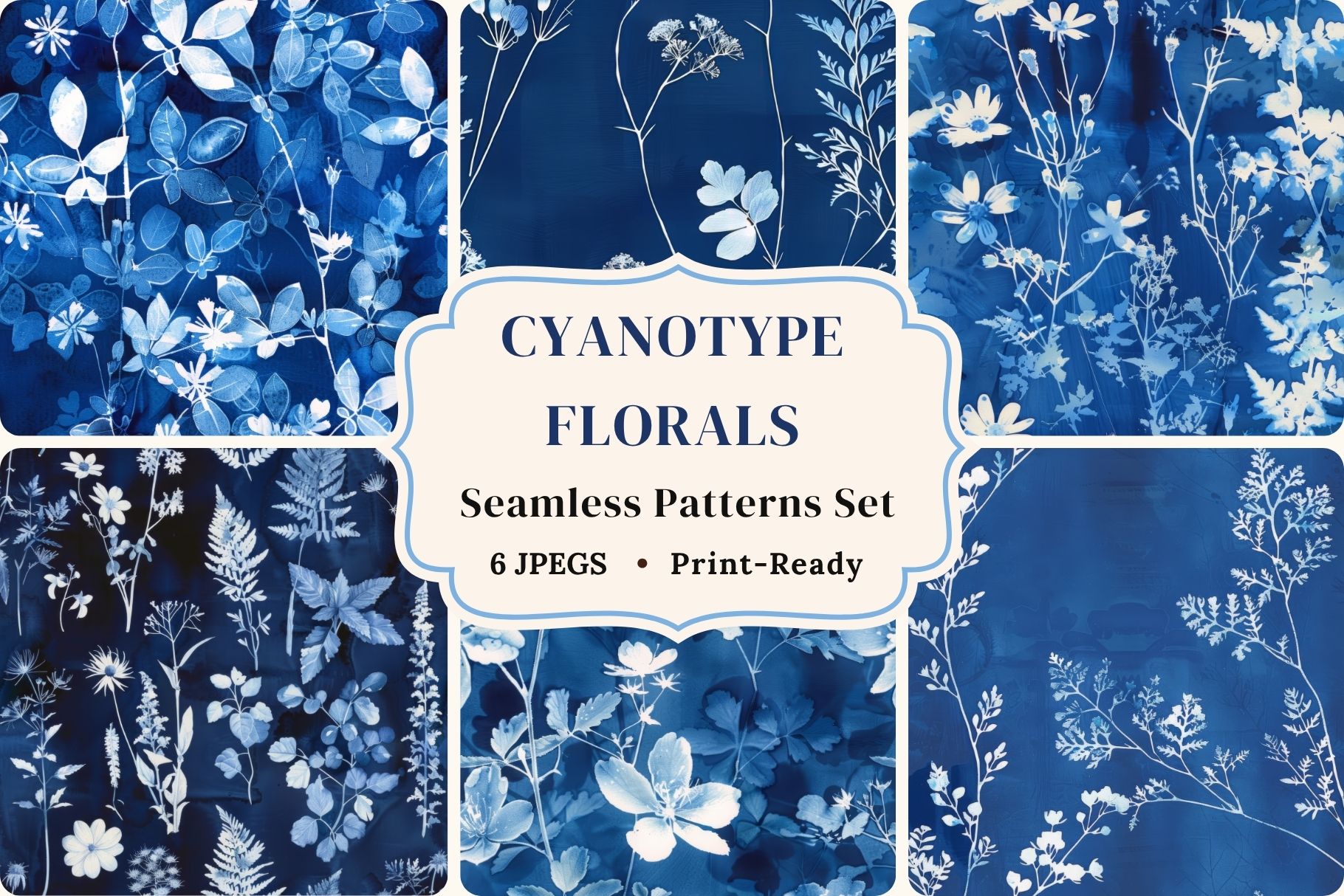
Patterio's cyanotype collection is built for exactly this need. Seamless, deep-blue botanical patterns that capture the cyanotype aesthetic, delicate leaf and stem silhouettes against rich blue grounds, designed to tile smoothly across fabric and reproduce cleanly at any scale. Each set is ready to license for commercial use, so a maker can move straight from file to fabric.
If the deep-blue look is calling, the cyanotype collection is the place to begin, with botanical patterns made to print across textiles, wallpaper, and stationery. For the wider story of how this look lives in interiors, our guide to cyanotype patterns for home decor covers the room-by-room view. And for more on designing fabric with botanical pattern, see our guides to ditsy floral patterns for fabric and the broader botanical pattern trends.
A Final Word on Blue
The cyanotype look endures because it does something rare: it makes a deep, saturated blue feel calm rather than heavy, and it turns a simple leaf into something quietly beautiful. In 2026, with deep blues leading the color story and craft back in fashion, it is having a deserved moment on fabric.
Whether you expose your own prints in the garden or reach for a seamless pattern to carry a whole collection, the principle is the same. Keep the blue deep, keep the botanicals delicate, and let the contrast do the work. That is the whole secret of the cyanotype look, and it is as lovely on a cushion or a scarf today as it was in Anna Atkins's first blue pages.
Ready to start?
Browse seamless pattern bundles